WEBBRIDGE
agent-webbridge · MIT · runs on your computer
WebBridge / How it works
How it works
A request goes from your AI app to a local router, then to the daemon for the Chrome profile you named, then to the extension, which controls each tab separately.
Architecture Comparison
Old Single Slot vs. Fleet Routing
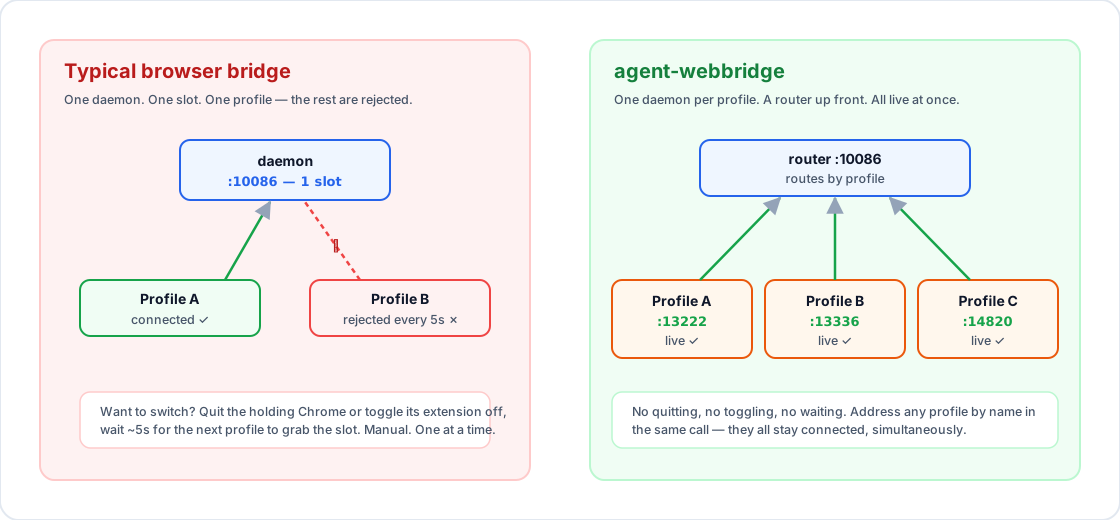
The Single-Slot Limitation
Some browser bridges enforce a single connection slot and a single global "current tab", so they drive exactly one tab per profile at a time. Attempting to connect a second Chrome profile results in connection rejection.
Simultaneous Session Isolation
We spawn one isolated background daemon per Chrome profile on deterministic hashed ports. Each Google account profile runs fully isolated with independent cookies and storage.
Transparent Router Gateway
The proxy router serves as the central API gateway on port
10086. It accepts standard HTTP / MCP commands, extracts the "profile" parameter, and forwards the payload transparently to the corresponding daemon.
What runs where
| Part | What it is |
|---|---|
| Chrome extension | A Manifest V3 extension. It attaches Chrome's debugger separately to each tab it controls. Permissions: debugger, tabs, tabGroups, storage, alarms, and access to all sites so it can act where you ask. It connects only to a daemon on 127.0.0.1. |
| Per-profile daemon | A small Node.js process, one per Chrome profile, on a port derived from the profile name. Its only runtime dependency is ws. |
| Router | Listens on 127.0.0.1:10086, reads the profile field of each request and forwards it to that profile's daemon. |
| Security guard | Since 1.3.1 the router and daemons refuse requests that carry a web page Origin or a non-loopback Host header. Versions before 1.3.1 did not, so update. |
| MCP server | npx -y agent-webbridge mcp exposes the browser tools to MCP apps over stdio. |
Where does my data go? Nowhere off your computer: there is no account, no telemetry and no remote server. Your AI app may send page content to its own model provider, which is separate from WebBridge.